



Why IRS Staffing Cuts Hit Small Business Owners Especially Hard
 Why IRS Staffing Cuts Hit Small Business Owners Especially Hard
The IRS has fewer people to answer your questions, but your tax deadlines have not changed.
Imagine opening an IRS letter on a Monday morning. It says your business owes money, but your records tell a different story. You call for an explanation. You wait. You call again. Meanwhile, payroll is due Friday, your suppliers need to be paid, and the letter has a response deadline.
For a small business owner, that is not just a paperwork problem. It is a business problem.
As a tax attorney, I believe business owners should understand what recent IRS staffing cuts could mean for them—and how to protect themselves.
Fewer Employees, More Pressure on Taxpayers
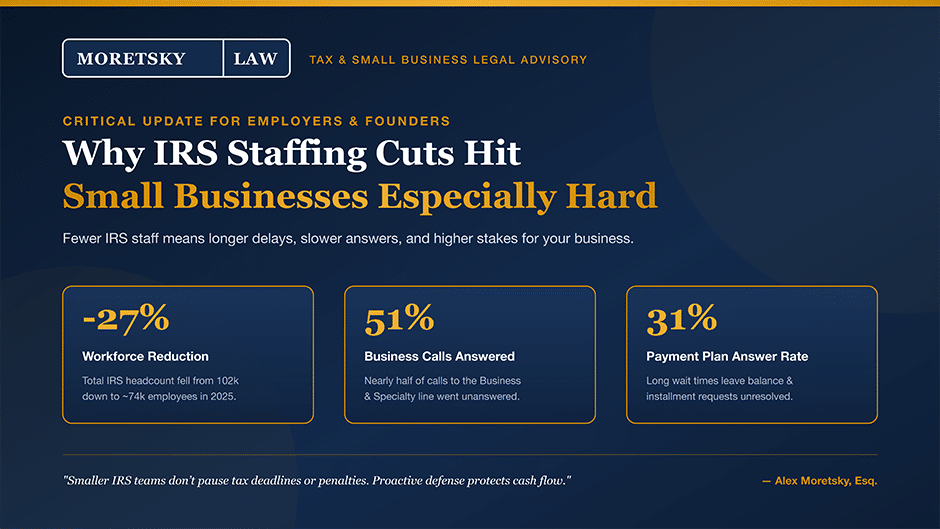
The IRS ended 2025 with approximately 74,000 employees, down from about 102,000 at the beginning of the year. That is a 27% reduction, according to the National Taxpayer Advocate.
To be fair, most taxpayers filed their 2025 returns successfully. But when something went wrong and a person needed individual attention, getting an answer was often more difficult.
During the 2026 filing season, IRS employees answered only 51% of calls to its Business & Specialty Tax Services line. On the Installment Agreement/Balance Due line, they answered just 31%, with an average wait of 45 minutes for calls that reached an employee.
Those numbers matter when you are trying to keep a business running.
Why Small Businesses Feel the Squeeze
Large companies may have accounting departments and dedicated tax professionals. A small business owner may be the person handling sales, hiring, invoices, and taxes—all in the same afternoon.
A delayed IRS response can create problems in several ways.
An unanswered notice creates uncertainty. You may need to clarify a payment, correct an account, or challenge an assessment. Until you get reliable information, it can be difficult to make confident financial decisions.
Tax debt can become harder to manage. If your business cannot pay in full, you may need to discuss collection alternatives or an installment agreement. Waiting to speak with someone does not automatically stop interest, penalties, or deadlines.
Your time has a real cost. Every hour spent trying to resolve a tax issue is an hour you cannot spend serving customers or growing your business.
The concern is not that every tax return will be delayed. It is that the businesses needing hands-on help may have the hardest time finding it.
What I Tell Business Owners to Do Now
My advice is simple: do not wait for an IRS problem to become an emergency.
First, open every IRS letter promptly. Check the tax period, the amount claimed, and the response date. Never assume a notice is harmless because you believe the IRS made a mistake.
Second, keep records you can actually find. Save filed returns, payment confirmations, payroll tax records, notices, and copies of anything you send to the IRS. Document dates and attempts to contact the agency.
Third, continue meeting your current tax obligations. A dispute involving an earlier period does not excuse missing new filing or payment deadlines.
Finally, ask for professional guidance early, especially when the issue involves unpaid payroll taxes, a proposed assessment, or possible collection action. Your options—and the time available to pursue them—depend on the notice and your circumstances.
You Should Not Have to Navigate This Alone
Smaller IRS teams do not make tax obligations disappear. They may simply make complicated situations more frustrating to resolve.
I cannot promise that every IRS issue can be fixed quickly, but I can help business owners understand what a notice means, evaluate available options, and take the next step with a clearer plan.
If an IRS notice is putting pressure on your business, address it before the deadline becomes another problem.
Alex Moretsky is a tax and small business attorney who helps clients navigate IRS disputes, tax debt, and related legal concerns.