



The Benefits and Drawbacks of a Limited Partnership
The Benefits and Drawbacks of a Limited Partnership
When structuring a business, choosing the right entity is critical. When considering the types of entities available, a limited partnership (LP) does not often come to mind. In certain circumstances, however, it makes the most sense, more so than a corporation or limited liability company. It offers unique advantages that make it an attractive choice for certain types of businesses and investors. This article explores the benefits of forming a limited partnership and compares it to other entities, such as limited liability companies (LLCs) and corporations, to determine when an LP might be the right fit.
Key Benefits of a Limited Partnership
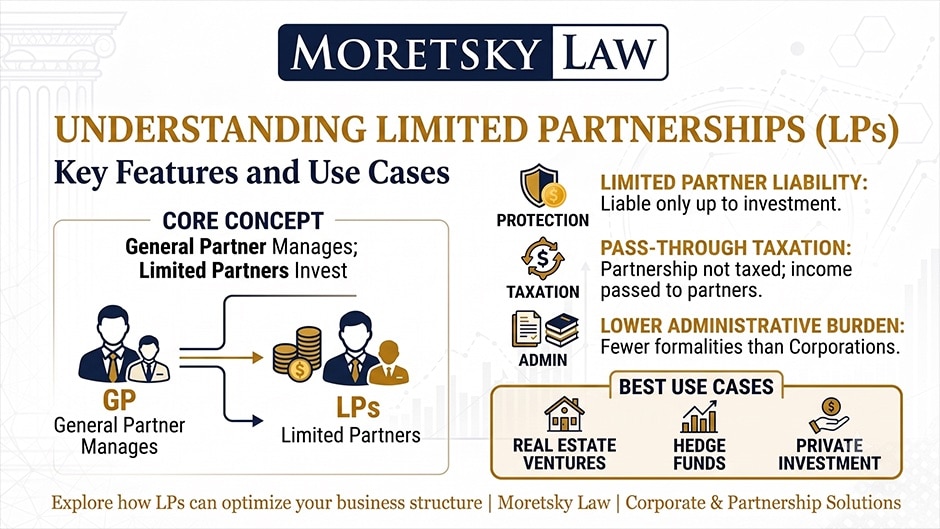
Liability Protection for Limited Partners. One of the most significant advantages of an LP is the liability shield it provides to limited partners. Limited partners are liable only for the debts and obligations of the partnership up to the amount of their investment. This protection encourages passive investors to contribute capital without exposing their personal assets to business risks. However, it is important to note that general partners in an LP do not enjoy this liability protection and are typically personally liable for the partnership’s obligations. This drawback may be overcome by appointing another legal entity, such as an LLC, as the general partner.
Pass-Through Taxation. Limited partnerships benefit from pass-through taxation, meaning the partnership itself is not taxed at the entity level. Instead, profits and losses are passed through to the partners, who report them on their individual tax returns. This avoids the double taxation that corporations often face and allows partners to apply their share of losses to offset other taxable income. Additionally, limited partners may benefit from deductions on their share of losses, which can be particularly advantageous in investment-heavy ventures.
Ease of Raising Capital. LPs are well-suited for businesses that require significant capital investment. The structure allows for the addition of multiple limited partners who contribute capital without participating in management. Because there is no cap on the number of investors in an LP, raising additional capital does not require much additional paperwork. This makes LPs particularly attractive for real estate ventures, hedge funds, and other investment partnerships where passive investors seek returns without operational involvement.
Flexibility in Management. LPs offer flexibility in management. Specifically, the management structure is streamlined, with general partners handling day-to-day operations while limited partners remain passive. This division of roles can simplify decision-making and operational control.
Lower Regulatory and Administrative Burden. Compared to corporations, LPs generally have fewer formalities, less ongoing paperwork, and lower formation and maintenance costs. This makes them an attractive option for businesses seeking a simpler and more cost-effective structure.
Estate and Tax Planning Advantages LPs can be used as effective tools for estate planning. They allow for the consolidation of family assets, centralized management, and the ability to make intra-family loans or gifts without fractionalizing assets.
When a Limited Partnership Is Preferable
While LPs offer numerous benefits, they are not always the best choice for every business. Below are scenarios where an LP may be preferable to other entities, such as LLCs or corporations:
Passive Investment Ventures. LPs are ideal for businesses with one or a few active managers and multiple passive investors. For example, real estate development projects, private equity funds, and hedge funds often use the LP structure to attract investors who want limited liability and no involvement in management.
When General Partner Liability is Acceptable. In cases where the general partner is willing to assume personal liability or where the general partner is a separate LLC (to shield individuals from liability), an LP can be a practical choice. This hybrid approach combines the benefits of an LP with the liability protection of an LLC for the general partner.
When an LLC or Corporation Might Be Better
Despite the advantages of LPs, there are situations where an LLC or corporation may be a better fit:
Active Participation by All Members. LLCs typically allow all members to participate in management without risking personal liability, unlike LPs where limited partners lose their liability protection if they engage in management.
Startups and High-Growth Businesses. LLCs and corporations are often better suited for startups and businesses seeking venture capital, as they offer more flexibility in ownership and management structures.
Avoiding General Partner Liability: As discussed above, the general partner of an LP is personally liable for the partnership’s obligations. In contrast, LLCs and corporations shield all owners from personal liability. To avoid personal liability, LPs typically name an LLC (or other legal entity) with limited assets to act as the general partner. In the event an individual is listed as the general partner, obtaining the proper type and level of insurance becomes extremely important.
Conclusion
Limited partnerships offer a unique combination of liability protection for limited partners, pass-through taxation, and flexibility in management and structure. They are particularly well-suited for passive investment ventures, real estate projects, and businesses seeking to attract capital from investors who prefer limited involvement. However, the general partner’s liability and restrictions on limited partner participation in management may make LLCs or corporations more appropriate for certain businesses. Ultimately, the choice of entity should be guided by the specific goals, risks, and operational needs of the business. Speak with an experienced attorney to understand your rights and obligations to determine which structure is best for you.